
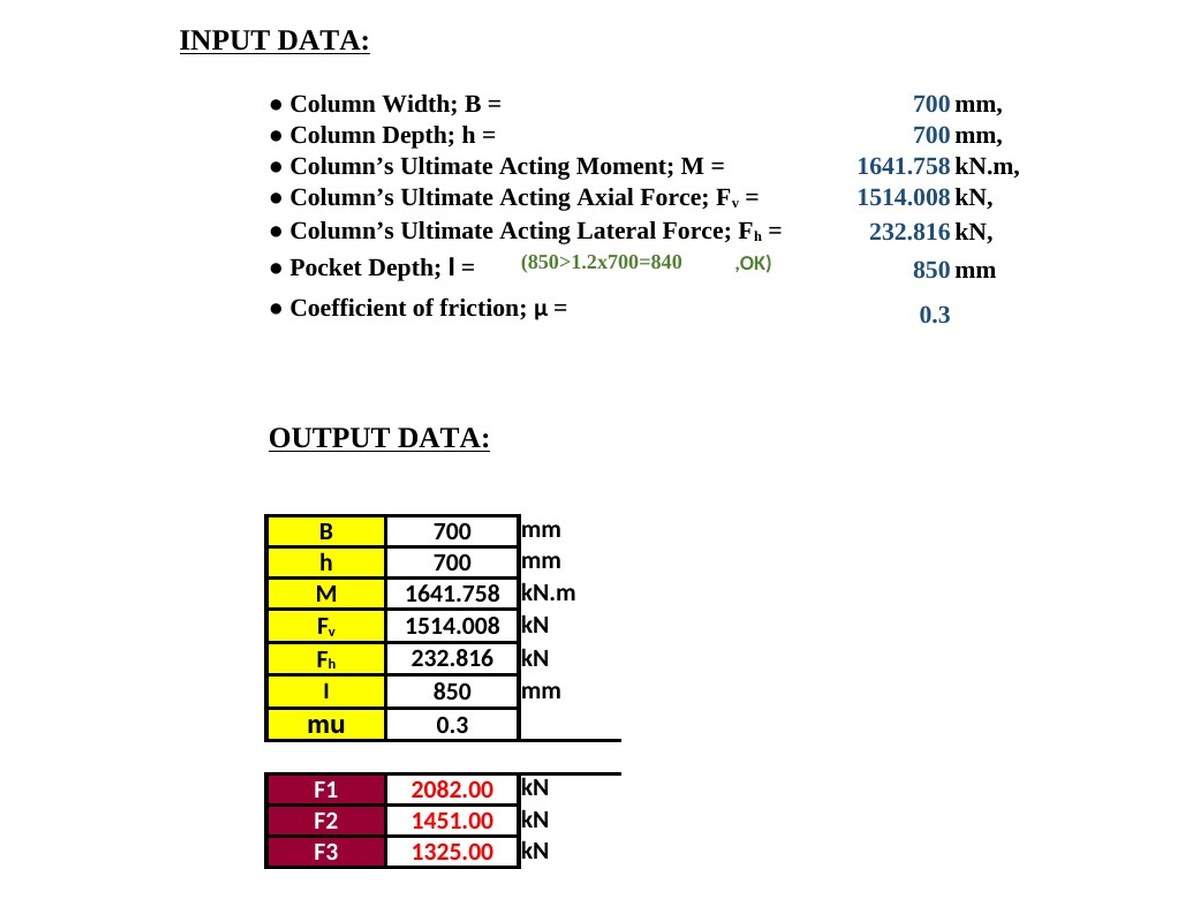
Input and Output Data
The column forces and pocket geometry go in at the top. The sheet confirms the pocket depth (at least 1.2 times the column depth) and returns the three wall forces F1, F2 and F3.
Design checks
Forces on the pocket walls
Solves the three equilibrium equations for a smooth joint surface with grout friction (μ = 0.3) to find the horizontal wall forces at the top and bottom of the pocket and the vertical force at the base.
Shear friction in the pocket wall
Designs the pocket's vertical links for direct shear transfer of the top wall force using the ACI 318 shear-friction equation.
Flexure and shear of the pocket wall
Treats each wall as spanning between the perpendicular walls, combines the flexural steel with the shear steel, and selects the horizontal closed links.
Column shear within the pocket
Checks that the column's own reinforcement resists the top wall force by shear friction inside the pocket.
Vertical steel for friction force
Combines the shear-friction steel with the steel needed for the friction force on the wall and selects the vertical bars on each face.
Punching of the footing
Checks the footing below the column base for punching shear under the base force F3.
Specifications
| Standard | ACI 318 (shear friction, flexure, punching shear) |
| Method | Pocket foundation with smooth joint surface; forces from equilibrium with wall friction |
| Inputs | Column width and depth, factored M, Fv and Fh, pocket depth, friction coefficient |
| Output | Wall forces, required and provided reinforcement for links and vertical bars, punching check |
| Format | Excel workbook with marked input cells |