
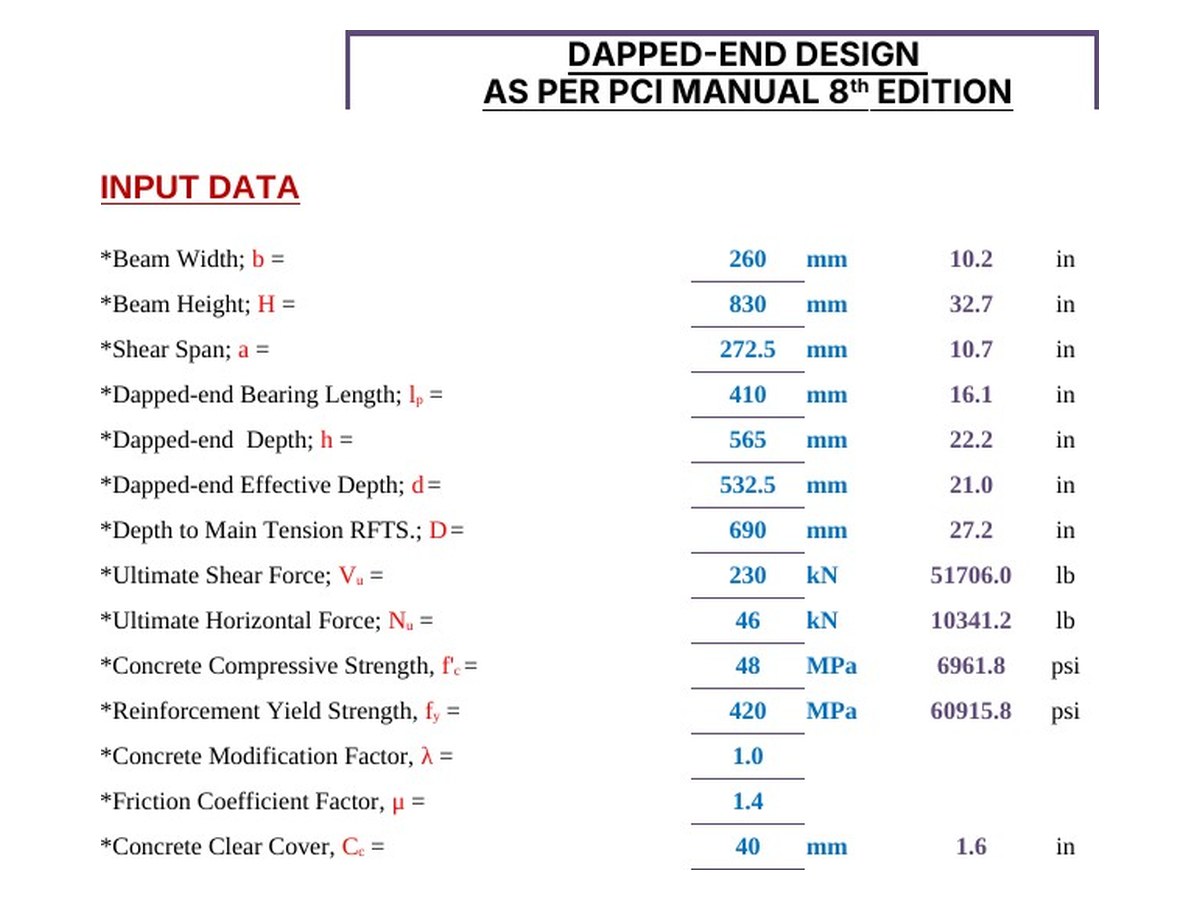
Input Data
Inputs are entered in SI units and shown in imperial units next to them, so every value can be checked directly against the PCI equations.
Design checks
Flexure and axial tension in the extended end
Calculates the primary tension steel As = Af + An from the factored shear, the shear span and the horizontal restraint force.
Direct shear (shear friction)
Checks the vertical crack at the face of the dap, using the effective friction coefficient μe limited by the PCI table values, and gives Ah and the shear capacity φVn.
Diagonal tension at the re-entrant corner
Sizes the hanger reinforcement Ash and A′sh to carry the full reaction across the re-entrant corner crack, with two bar options.
Diagonal tension in the extended end
Checks the concrete capacity of the nib and gives the vertical reinforcement Av, with the minimum steel requirement.
Anchorage and detailing
Checks the shear span-to-depth ratio (a/d < 1.0), the dap depth against half the beam depth, the flexural stress beyond the dap, hanger bar bend radius and the shear limits over 2H beyond the dap.
Bar selection
Converts each required area into a bar arrangement and confirms the bars fit in one layer within the stem width.
Design Output
Each result is shown next to the PCI equation it comes from, so a reviewer can follow the calculation line by line.
Summary of Reinforcement
Specifications
| Standard | PCI Design Handbook, 8th Edition (Section 5.6.3), with ACI 318 load and strength reduction factors |
| Elements | Precast beams, double tees, inverted-tee and L-beam ledges with dapped ends |
| Inputs | Section and dap geometry, factored vertical and horizontal reactions, f′c, fy, λ, μ, cover |
| Output | Required steel for each reinforcement group, selected bars, and pass/fail checks on one printable sheet |
| Format | Protected Excel workbook with locked formulas and marked input cells |